Strategic Technical Due Diligence

From Code to Certainty

Trusted Code Base provides deterministic technical audits that translate software risk into valuation clarity, legal defensibility, and deal momentum.

Trusted Code Base advisory presentation

Pillar Content

The Top 5 Technical Deal-Killers: Forensic Insights for the Modern Investor

1. The IP Poison Pill: AGPL & Strong Copyleft

Modern software is built on open source, but not all open source is "free." We frequently find AGPL or GPL-licensed libraries integrated into the core proprietary modules of a target company. If the software is delivered as a service (SaaS), this can trigger "reciprocal" obligations, potentially requiring the company to release its entire proprietary codebase to the public. We identify these "poison pills" at the design phase.

2. Infrastructure "Zombie" Liability

Cloud environments like Azure and AWS provide speed, but often at the cost of security. We identify "Owner" level permissions granted to developers at the broad subscription scope—a massive liability for data exfiltration. Furthermore, we audit for "Zombie" infrastructure: public-facing storage buckets and databases with no logging or diagnostics enabled, making a breach both likely and untraceable.

3. The API Design Blindspot

An API is the front door to a company’s data. We audit OpenAPI specifications to ensure that "Write" operations (POST/PUT/DELETE) are strictly authenticated. A common deal-killer is the discovery of "Shadow APIs"—undocumented endpoints that allow unauthenticated access to sensitive PII, representing a catastrophic regulatory risk.
Exclusive Resource for PE Associates

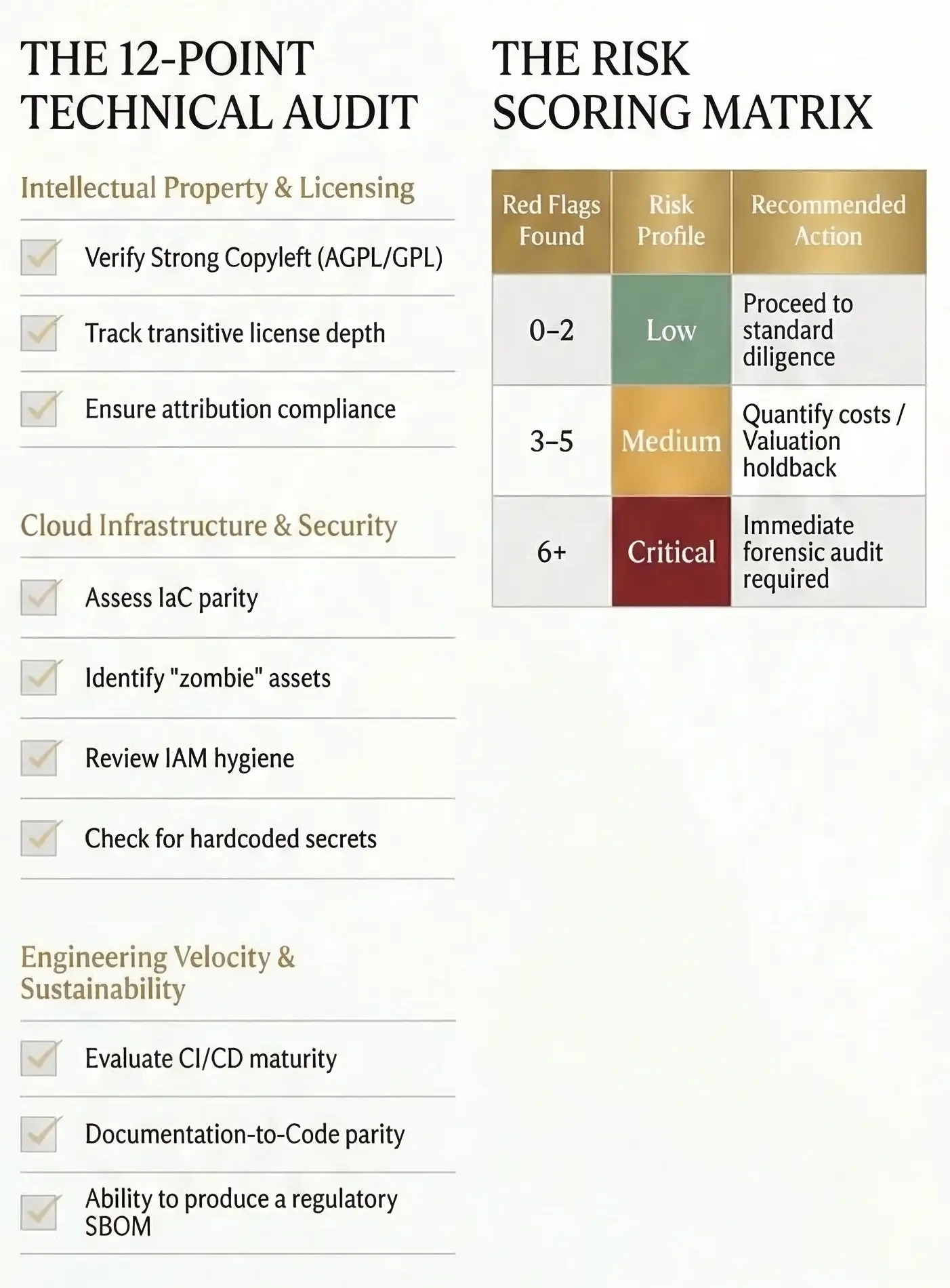
The 48-Hour Technical Due Diligence Checklist

Stop guessing. Download the proprietary 12-point checklist we use to flag critical "deal-killers" (IP risks, Zombie Infra, API gaps) before the LOI goes binding.

Trusted Code Base 12-Point DD Checklist PDF Cover

4. Transitive Dependency "Icebergs"

Most scanners look at direct dependencies. Trusted Code Base goes deeper. We analyze the transitive depth—the libraries that the target's libraries are using. Often, a "clean" direct dependency is pulling in a high-severity vulnerability or a blocked license three layers deep. Our audit exposes the full depth of the supply chain.

5. Hero-Dependent Architecture

During our design-time audit, we look for documentation-to-code parity. When a company has a 50,000-line codebase but no structured API documentation or IaC (Infrastructure as Code) definitions, it indicates Hero-Dependency. The value is in the heads of two developers, not the system. This represents a massive "Key Person" risk for any acquirer.